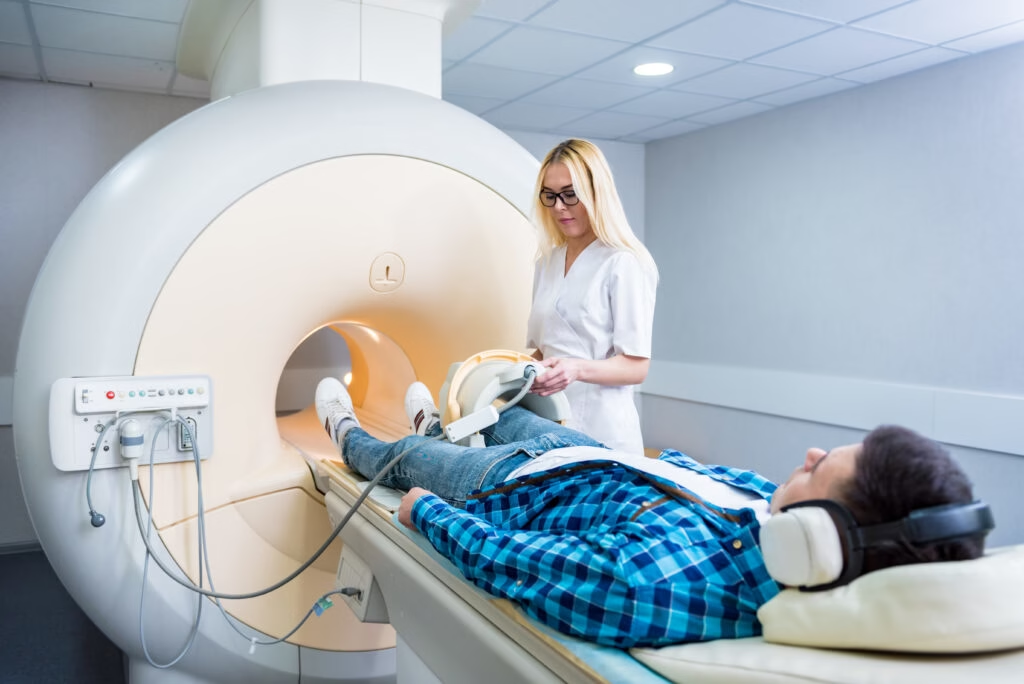
Knee MRI Cost in Pune:
If your doctor has just handed you a prescription for a knee MRI, you probably have two questions running through your head at the same time: “How much is this going to cost me?” and “Wait, what exactly is this scan going to show?”
Most guides only answer the first question. We’re going to answer both — properly.
How Much Does a Knee MRI Cost in Pune?
Knee MRI prices in Pune typically start from around ₹4,000 for a plain scan, and go up to ₹6,500–7,500 if contrast dye is required. Where you land in that range depends on three things: whether it’s a 1.5T or 3T machine, whether contrast is needed, and which centre you choose.
| Type of Knee MRI | Approximate Price Range |
|---|---|
| Plain Knee MRI (1.5T) | ₹4,000 – ₹5,500 |
| Plain Knee MRI (3T) | ₹5,000 – ₹6,500 |
| Knee MRI with Contrast | ₹6,000 – ₹7,500 |
| Bilateral (Both Knees) | ₹7,500 – ₹11,000 |
These are typical ranges across our partner network in Pune — the exact price at your chosen centre will be confirmed before you book. For a full breakdown across all body parts and localities, our complete MRI cost guide is worth a look.
Now, let’s get into the part almost nobody explains properly.
“My X-ray Was Normal — Why Does My Doctor Want an MRI?”
This is genuinely the most common question we hear from knee patients, and it’s rarely answered anywhere.
Here’s the short version: an X-ray only shows bone. It’s excellent at spotting fractures, bone spurs, and joint space narrowing from arthritis. But it’s completely blind to soft tissue — your ligaments, meniscus, cartilage, and tendons simply don’t show up on an X-ray at all, because X-rays pass straight through soft tissue without much resistance.
An MRI works differently. It uses magnetic fields to build a detailed picture of exactly the tissue an X-ray can’t see. So when your knee X-ray comes back “normal” but the pain, swelling, or instability is still there, your doctor isn’t second-guessing themselves — they’re simply moving to the tool that can actually see what’s going on.
If this happened to you, it doesn’t mean something serious was missed on the X-ray. It usually just means your source of pain is soft-tissue, not bone, and an X-ray was never going to catch it in the first place.
Understanding Your Knee MRI Prescription
Prescriptions are written fast, in shorthand, and rarely explained. If yours has any of these phrases, here’s what they actually mean:
“MRI Right Knee Plain” — a standard scan of one knee, no contrast dye involved. This covers the vast majority of knee MRI prescriptions.
“MRI Both Knees” — a bilateral scan, meaning both knees are imaged in the same sitting. Doctors usually order this when symptoms are present on both sides, or for comparison purposes.
“MRI Knee Arthrogram” — this one confuses a lot of patients. An arthrogram is a specific technique where contrast dye is injected directly into the joint space (not just into a vein) before the scan, giving a sharper view of the joint lining and cartilage surface. It’s used far less often than a routine scan, typically when a doctor needs a very detailed look at the joint structures.
If your prescription has a term you don’t recognise, it’s always worth a quick call to the centre to confirm — takes two minutes and avoids any confusion on the day of your scan.
Plain vs Contrast Knee MRI — Do You Actually Need Contrast?
Here’s something that quietly causes a lot of unnecessary price anxiety: most patients assume contrast is a default part of any MRI. For knees, it usually isn’t.
Contrast dye is typically reserved for specific situations — most commonly when a doctor suspects an infection or a mass in the joint. For the far more common reasons people get a knee MRI — ligament injuries, meniscus tears, general joint pain, arthritis evaluation — a plain scan is usually all that’s needed.
That matters for your wallet too. Since contrast is the exception rather than the rule for knees, most patients end up paying the plain-scan price, not the higher contrast price. If your prescription doesn’t explicitly mention contrast or “arthrogram,” there’s a good chance you won’t need it — though your doctor’s specific instructions always take priority over any general rule.
What a Knee MRI Actually Shows, Condition by Condition
This is the part that turns a confusing prescription into something that actually makes sense.
ACL and Other Ligament Tears
The ACL (anterior cruciate ligament) is one of the most common reasons active people end up needing a knee MRI, especially after a sudden twisting injury during sport. A physical exam can suggest a ligament tear, but it can’t always tell how severe it is or whether other structures are also affected. MRI shows the ligament directly — whether it’s partially or fully torn, and whether nearby structures like the meniscus were also affected in the same injury.
Meniscus Tears
The meniscus is cartilage that cushions the knee joint, and tears here are extremely common — both from sudden twisting injuries and from gradual wear over the years. MRI is the standard way to confirm a meniscus tear because it can show not just that a tear exists, but where exactly it is and how it’s shaped, which affects whether it can heal on its own or needs treatment.
Cartilage Damage
Early cartilage wear is one of those things that often doesn’t show up on an X-ray at all, since X-rays only reveal cartilage loss indirectly (through narrowed joint space) once it’s already fairly advanced. MRI can pick up early cartilage thinning and damage well before it reaches that stage.
Arthritis and Joint Degeneration
X-rays are actually reasonably good at showing advanced arthritis — but MRI adds detail an X-ray simply can’t: the condition of the cartilage surface, any inflammation in the joint lining, and early changes that haven’t yet caused visible bone changes on an X-ray.
Knee MRI for Runners, Gym-Goers & Athletes in Pune
If you’re one of the many runners training along the river paths, a regular at a Baner or Kothrud gym, or someone who plays weekend cricket or football, this section is for you.
Active knees get hurt differently than sedentary ones. A sudden twist while changing direction, a hard landing after a jump, or that specific “pop” feeling during a match — these are classic signs your doctor will want imaged properly rather than guessed at.
The temptation with an active injury is to rest for a few days, feel better, and get straight back to training. The problem is that a partially torn ligament or meniscus can feel deceptively okay for a while before failing again, often worse, mid-activity. An MRI early on gives you (and your doctor) a clear answer, rather than a guess — which usually means less time off in the long run, not more.
book a same-day knee MRI at www.mripune.in

Why Do Doctors Recommend Knee MRI Scans?
Doctors suggest knee MRIs to diagnose:
- Ligament tears (ACL, PCL, MCL, LCL)
- Meniscus injuries
- Arthritis assessment
- Bone fractures
- Unexplained swelling or inflammation
- Tumors and joint infections
- Sports and trauma-related injuries
- Pre-surgery planning and post-surgery review
Advanced MRI Technologies Available in Pune
- 3 Tesla (3T) scanners for clearer, faster images
- Open MRI for claustrophobic or large patients
- Silent MRI for noise-sensitive individuals
- Dedicated knee coils for sharper joint detail
Preparing for Your Knee MRI Appointment
Essential Documents to Carry:
- Doctor’s prescription and referral letter
- Previous medical reports and imaging studies
- Valid government ID proof
- Insurance cards or health scheme documents
- List of current medications and allergies
Pre-scan Preparation:
- Follow specific instructions from your healthcare provider
- Inform about claustrophobia or anxiety concerns
- Arrange transportation if sedation is required
- Wear comfortable, metal-free clothing
Questions to Ask:
- What type of MRI machine will be used?
- Is contrast dye necessary for my condition?
- How long will the procedure take?
- When will the results be available?
- Are digital copies included in the cost?
check if you qualify for a free or subsidised scan
Understanding Your Knee MRI Results
After your scan, a qualified radiologist will analyze the images and prepare a detailed report. The referring doctor will explain the findings and discuss treatment options if they detect any abnormalities.
Normal Results:
- Healthy bone structure and alignment
- Intact ligaments and cartilage
- No signs of inflammation or fluid accumulation
- Normal blood vessel patterns
Abnormal Findings May Include:
- Ligament tears or sprains
- Meniscus damage or degeneration
- Arthritis-related changes
- Bone fractures or stress injuries
- Tumors or abnormal growths
- Joint inflammation or infection
Know more about prepration from how to Prepare for Mri ScanFrequently Asked Questions
How much does a knee MRI cost in Pune? Plain knee MRI scans in Pune typically range from ₹4,000 to ₹6,500, while scans requiring contrast dye range from ₹6,000 to ₹7,500. The exact price depends on the machine type and centre.
Is contrast needed for a knee MRI? Not usually. Contrast is typically reserved for specific situations like suspected infection or a mass in the joint. Most common knee complaints — ligament tears, meniscus injuries, arthritis — are evaluated with a plain scan.
What does “MRI Knee Arthrogram” mean? It’s a specific technique where contrast dye is injected directly into the joint space before scanning, giving a more detailed view of the joint lining and cartilage. It’s used less often than a routine knee MRI.
Can a knee MRI show a meniscus tear? Yes — MRI is the standard way doctors confirm a meniscus tear, since it shows the exact location and pattern of the tear, which affects treatment decisions.
Why did my doctor ask for an MRI when my X-ray was normal? X-rays only show bone. Ligaments, cartilage, and the meniscus don’t appear on an X-ray at all, so a normal X-ray with ongoing pain often means the next step is an MRI to look at the soft tissue directly.
Is knee MRI covered under insurance? In most cases, yes, when prescribed by a doctor. Coverage details — including cashless options — depend on your specific policy. Our complete cost guide has more on how MRI insurance claims typically work.
check your benefits on goverment scheme on PMJAYNot sure which scan your prescription is asking for, or want to check prices at a centre near you? WhatsApp us your prescription and we’ll help you figure out the right next step — no guesswork required.
Conclusion
Getting a knee MRI in Pune is easy and affordable. You can compare prices, use insurance or government plans, and book at trusted centers. Always check eligibility for schemes like Ayushman Bharat and CGHS, and feel free to consult Mripune.in for ease of booking and further assistance