
Spine MRI Cost in Pune – Real 2026 Prices for Cervical, Lumbar & Thoracic MRI, What Affects Cost & How to Book
Back pain is one of those problems that sneaks up on you. It starts as a dull ache after a long day. Then it becomes a stiffness that does not go away in the morning. Then comes the tingling down your leg or the numbness in your arm. You go to a doctor, get an X-ray, and the report says something vague like “mild degenerative changes” or even “no significant findings.”
And then the doctor writes a prescription for a spine MRI.
You look at the slip. It says “MRI LS Spine Plain” or “MRI C-Spine” — and you have no idea what that means, let alone What is the actual spine MRI cost in Pune — and is there an affordable MRI for back pain in Pune near where you live?
This is where most patients in Pune get stuck. Not because spine MRI is complicated, but because nobody has taken the time to explain it properly. What part of the spine is being scanned? Why is the doctor only scanning one region when the pain feels like it is everywhere? And what is the actual cost at a real center in Pune?
At MRI Pune, we work with NABL-certified partner centers in all over Pune and we are actively expanding our network across the city. Our job is simple: give you the exact spine MRI cost in Pune before you go, explain what your prescription means, and book the right scan at the right center in one call.
This guide gives you all of that.
How Much Does a Spine MRI Cost in Pune?
Spine MRI cost in Pune varies depending on which region is being scanned, whether the scan is plain or with contrast, and the type of machine used. Across Pune, the price difference between centers for the same scan can be significant — which is why knowing the average range before you call saves time and prevents surprises.
Here is the average spine MRI cost in Pune across NABL-certified diagnostic centers:
| Spine MRI Type | Average Cost in Pune |
|---|---|
| Cervical Spine MRI (Plain) | ₹3,500 – ₹6,000 |
| Lumbar (LS) Spine MRI (Plain) | ₹3,500 – ₹6,000 |
| Thoracic Spine MRI (Plain) | ₹3,500 – ₹6,000 |
| Spine MRI with Contrast | ₹5,500 – ₹9,000 |
| 3 Tesla Spine MRI | ₹5,500 – ₹9,500 |
| Whole Spine Screening (WSS) | ₹8,000 – ₹18,000 |
| Two Regions (e.g. Cervical + Lumbar) | ₹6,500 – ₹11,000 |
The lumbar spine MRI cost in Pune and cervical spine MRI cost in Pune fall in a similar range for plain scans — the region does not significantly affect the base price. What moves the cost is contrast and machine type.
These are average ranges across NABL-certified centers in Pune — not the highest-end hospital rates, not the suspiciously low prices you sometimes see on aggregator websites. The actual cost depends on which center you book, the machine quality, and exactly what your prescription specifies.
At our partner centers, pricing is confirmed before you book — no last-minute additions at the billing counter. Call us with your prescription and we tell you the exact cost upfront, along with the nearest available center and slot.
One important point if your prescription covers more than one spinal region — for example, both cervical and lumbar spine: always call before booking both separately. Combined pricing for two regions at the same center is almost always more affordable than booking each one independently, and the saving can be significant.
We are also expanding our partner center network across Pune — adding locations in Kothrud, Baner, Wakad, Hinjewadi, Viman Nagar, and Pimpri-Chinchwad. If you are in any of these areas, call us before assuming nothing is available near you. The network grows every month.
read “MRI scan cost in Pune”
Cervical, Thoracic, and Lumbar — Which Part of Your Spine Is Being Scanned and Why?
This is the question most patients have but never actually ask their doctor — because the appointment moves fast and there is never quite enough time.
Here is the honest answer. Your spine has three separate regions that can be scanned individually. Each region covers a different set of vertebrae and is associated with a different set of symptoms and conditions. When your doctor prescribes a spine MRI, they select the region based on your symptoms and their clinical examination — not on where the pain feels worst to you.
This matters because pain felt in one part of your body often originates somewhere else in the spine entirely.
The cervical spine covers the neck — vertebrae C1 to C7. If you have neck pain combined with tingling, numbness, or weakness in your arms, hands, or fingers — your doctor is looking at the cervical spine. The nerve roots that control your arms emerge from this region, which is why a compressed nerve at C5–C6 can cause symptoms that feel like they are in your hand.
If you are looking for cervical spine MRI cost in Pune specifically, call us — pricing depends on the center and whether contrast is required.
The thoracic spine covers the mid-back — vertebrae T1 to T12. This is the least commonly scanned region because the thoracic spine is naturally more stable and less prone to disc herniation than the cervical or lumbar regions. Mid-back pain with no clear nerve pattern, post-trauma assessment, or spinal cord evaluation are the usual reasons for a thoracic MRI.
The lumbar spine covers the lower back — vertebrae L1 to L5. This is by far the most commonly scanned spinal region in Pune. Lower back pain that radiates into the leg, sciatica, suspected slip disc at L4–L5, and nerve compression causing weakness or numbness in the leg — all of these are lumbar spine investigations. Your prescription will say “MRI LS Spine” or “MRI Lumbar Spine.”
If you are looking for lumbar spine MRI cost in Pune specifically, call us — pricing depends on the center and whether contrast is required.
Whole spine screening — abbreviated as MRI WSS — covers all three regions in a single session. This is prescribed for scoliosis assessment, widespread degenerative changes, post-trauma evaluation, or when the doctor needs to see the full structural picture before planning treatment.
So when your prescription says “MRI LS Spine” and you are wondering why the doctor is not scanning your neck too — it is because your symptoms and examination point specifically to the lumbar region. That is precise, not incomplete.
How to Read Your Spine MRI Prescription Before You Call
Let us take a real example. Your prescription says: “MRI LS Spine Plain.”
Here is what each part means:
MRI — the imaging modality. Magnetic Resonance Imaging. LS Spine — lumbar spine. The lower back, L1 to L5. Plain — no contrast dye. No injection required.
That is a straightforward lumbar spine MRI with no contrast — one of the most commonly booked scans at our partner centers in Pune, and one of the more affordable spine MRI types because it is plain, routine, and takes under 25 minutes.
Now here is the decoder for every variation you might see on a spine MRI prescription in Pune:
| What Your Prescription Says | Region | What It Means | Average Cost in Pune |
|---|---|---|---|
| MRI LS Spine Plain | Lumbar (lower back) | Routine lumbar MRI, no contrast | ₹3,500 – ₹6,000 |
| MRI C-Spine Plain | Cervical (neck) | Routine cervical MRI, no contrast | ₹3,500 – ₹6,000 |
| MRI Cervical Spine with Contrast | Cervical (neck) | Cervical MRI with IV dye | ₹5,500 – ₹9,000 |
| MRI Dorsal Spine / MRI T-Spine | Thoracic (mid-back) | Mid-back MRI, no contrast | ₹3,500 – ₹6,000 |
| MRI WSS | Full spine | Whole spine screening | ₹8,000 – ₹18,000 |
| MRI LS Spine + Cervical | Lumbar + Cervical | Two regions — combined pricing available | ₹6,500 – ₹11,000 |
| MRI 3T Lumbar Spine | Lumbar | Specifically needs 3 Tesla machine | ₹5,500 – ₹9,500 |
| MRI LS Spine Special View SI-J | Lumbar + SI Joint | Includes sacroiliac joint view | Confirm on call |
If your prescription says anything other than “plain” — read it out word for word when you call us. Two minutes of clarity prevents you from booking the wrong scan, arriving at the centre unprepared, or paying more than you needed to.
What Does a Spine MRI Actually Diagnose?
Slip Disc — The Most Common Reason for a Lumbar Spine MRI in Pune
A slip disc — or to use the medical term, a herniated intervertebral disc — is what happens when the soft inner material of a spinal disc pushes through its outer casing and presses on a nearby nerve root.
It does not show on an X-ray. Discs are soft tissue, and X-rays only capture bone. This is why patients come back from an X-ray with a “normal” result and still feel pain radiating down their leg — the bone is fine, but the disc next to it is not.
The lumbar spine MRI shows exactly which disc has herniated — L4–L5 is the most common level in Pune patients — which direction the herniation has gone, and whether it is pressing on a nerve root and how significantly. This information is what your orthopaedic surgeon or neurosurgeon uses to make the most important treatment decision: conservative management with physiotherapy and medication, or surgical intervention.
Without the MRI report, that decision is guesswork. With it, it is a clinical judgement based on evidence.
Sciatica — Why the MRI Is on Your Spine, Not Your Leg
If you have been told you have sciatica, you already know what it feels like — a shooting, burning, or electric pain that starts somewhere in your lower back or buttock and travels down one leg, sometimes all the way to the foot.
What many patients do not know is why their doctor has prescribed an MRI of the spine when all the pain is in the leg.
The sciatic nerve is formed from nerve roots that emerge from the lumbar spine between L4 and S1. When a disc herniation, bone spur, or narrowing of the spinal canal compresses one of these roots, the pain travels along the entire nerve pathway — which is why it feels like a leg problem when the actual issue is in your lower back.
A lumbar spine MRI shows which nerve root is being compressed, at which vertebral level, and what is causing the compression. That is the diagnosis your doctor needs before any treatment plan can be made — whether that is targeted physiotherapy, a nerve root injection, or surgery.
Cervical Spondylosis and Neck Pain
Cervical spondylosis is degenerative change in the cervical spine — the discs lose height, the joints develop bony spurs, and the spaces through which nerve roots exit can narrow. It is extremely common in Pune, particularly among people who spend long hours at desks and screens.
The presentation is usually neck stiffness with pain, combined with tingling or numbness that radiates into one or both arms, hands, or fingers. Sometimes there is weakness in the grip. Sometimes the pain goes up into the back of the head.
A cervical spine MRI shows the exact level and extent of the degeneration, whether any nerve roots are being compressed, and whether the spinal cord itself is involved. This last point matters because cord compression — called myelopathy — requires more urgent attention than isolated nerve root compression.
Most patients with cervical spondylosis find that their MRI report helps their doctor design a targeted treatment plan rather than just prescribing general pain relief. Knowing which level is affected and whether there is nerve involvement makes physiotherapy, medication, and any intervention much more precise.
Spinal Canal Stenosis, Post-Surgery Review, and Other Conditions
Spinal canal stenosis is a narrowing of the canal through which the spinal cord runs. When it narrows beyond a certain point, it causes symptoms that can mimic multiple conditions — bilateral leg weakness, difficulty walking, loss of bladder control in severe cases. The MRI shows the exact level, the degree of narrowing, and whether the cord or nerve roots are being compressed.
For patients who have already had spinal surgery, a follow-up MRI is the standard way to check how the repair is healing, confirm that the nerve decompression achieved what was intended, and identify any new issues that may have developed.
Scoliosis and other structural deformities are typically assessed with a whole spine screening — the same MRI but covering cervical, thoracic, and lumbar spine in one session, giving the surgeon a full picture of the spinal alignment and any curvature.
Plain vs Contrast Spine MRI — When Is the Injection Actually Needed?
For the vast majority of spine MRI patients in Pune — and we mean the overwhelming majority — plain MRI is all that is needed.
If your prescription says “MRI LS Spine Plain” or “MRI Cervical Plain” — you do not need an injection. No fasting, no IV line, no contrast dye. You arrive, change, lie in the scanner for 20 to 25 minutes, and leave. The cost is ₹3,500 at Swargate, ₹4,700 at Hadapsar.
Contrast dye — gadolinium, administered intravenously — is prescribed for spine MRI in specific situations: suspected spinal infection such as discitis or an epidural abscess, evaluation of a tumour or suspected metastasis in the spine, post-surgical assessment where the radiologist needs to distinguish between scar tissue and a recurrent disc herniation, or spinal cord inflammation such as myelitis or demyelinating disease. These are not routine back pain investigations. They are specific clinical questions that a plain MRI cannot fully answer.
What this means practically: if your doctor suspects a slip disc, nerve compression, sciatica, cervical spondylosis, or general spinal degeneration — your scan will almost certainly be plain. If your prescription says “with contrast” or you are unsure — call us before booking. We will read your prescription, explain what is required, and give you the exact cost upfront so there are no surprises at the center.
What Actually Affects Spine MRI Cost in Pune?
Understanding what drives the price helps you ask the right questions before booking — and avoid paying more than your scan actually requires.
The spine region being scanned is the first factor. Cervical, thoracic, and lumbar MRI each have their own pricing — and whole spine screening that covers all three regions is priced differently again. If your doctor has prescribed two regions, always call us before booking. Combined pricing is often more affordable than booking each region separately, and we confirm this for your specific prescription before you book anything.
Machine type — 1.5T vs 3T — is the second factor, and it is the one most patients misunderstand. The vast majority of spine MRI prescriptions in Pune do not specify a Tesla strength. When your doctor writes “MRI LS Spine Plain,” they almost always expect a 1.5T scan. That machine is perfectly capable of showing disc herniation, nerve compression, spinal canal narrowing, and all the conditions routinely investigated through spine MRI. A 3T spine MRI is only needed when your prescription specifically asks for it. Booking a 3T scan when your doctor expects a 1.5T means paying significantly more for no diagnostic benefit — so always call us before upgrading the machine type on your own.
Contrast vs plain is the third factor — covered in detail in the previous section. Plain spine MRI covers most back pain investigations and is the more affordable option for the majority of patients.
The centre’s location and type also affect price. Standalone NABL-certified diagnostic centers typically charge less than multispeciality hospital MRI departments for the same quality of scan and radiologist. The hospital is not giving you a better scan — it is giving you a more expensive one. As MRI Pune expands its partner network across Pune, more patients will have access to NABL-certified quality at diagnostic center pricing, closer to where they live.
Hidden charges to ask about before you book — always confirm these four things before finalising any spine MRI booking in Pune: is the radiologist reporting fee included in the quoted price? Are CD or film charges extra? If contrast is needed, get the exact rupee figure for the dye — not just “contrast extra.” And confirm whether the booking is scan-only or includes anything bundled in. These four questions take two minutes on the phone and prevent every surprise at the billing counter. At our partner centers, all of this is confirmed upfront when you call us.
What Does Your Spine MRI Report Actually Mean?
You will receive your MRI report within 24 hours at our partner centers. It will be a PDF or printed document with terminology that looks alarming if you do not know what you are reading.
Here is a plain English guide to the findings most commonly seen on spine MRI reports in Pune:
“L4–L5 disc herniation with right-sided nerve root compression” — the disc between the fourth and fifth lumbar vertebrae has herniated to the right, pressing on the nerve root on that side. This is the most common finding in patients with right-sided sciatica. Your doctor will assess whether the compression is significant enough to require intervention.
“Mild central canal stenosis at L3–L4” — the canal that houses the spinal cord has narrowed at this level. Mild means the narrowing is present but not severe. Your doctor will correlate this with your symptoms to determine whether treatment is needed.
“Loss of disc height at C5–C6 with foraminal narrowing” — the disc
between the fifth and sixth cervical vertebrae has thinned with age or degeneration, and the opening through which the nerve root exits has narrowed. Very common in desk workers over 35 in Pune. Whether this is causing your arm symptoms depends on the clinical picture.
“Mild diffuse disc bulge without significant canal compromise” — a disc is bulging slightly but not pressing significantly on the canal or nerve roots. This finding sounds dramatic but is often less serious than it appears. Many people have this finding with no symptoms at all.
“No significant neural compromise” — the nerves and spinal cord appear unaffected even if structural changes are present. Generally a reassuring finding.
“No significant abnormality detected” — a normal spine MRI. The pain has another cause that the scan did not show. Your doctor will investigate further.
Do not try to interpret your report alone. The same finding means something very different for a 32-year-old with acute onset symptoms versus a 58-year-old with chronic gradual changes. Your doctor has your full clinical picture — the report is one piece of it.
Frequently Asked Questions
What is the spine MRI cost in Pune in 2026? Spine MRI cost in Pune generally ranges from ₹3,500 to ₹6,000 for a plain lumbar, cervical, or thoracic MRI at NABL-certified diagnostic centers. Contrast MRI typically ranges from ₹5,500 to ₹9,000. 3T spine MRI ranges from ₹5,500 to ₹9,500. Whole spine screening costs more depending on the center. The exact cost depends on your prescription, machine type, and which center you choose. Call us with your prescription and we confirm the price for your specific scan — before you book anything.
What is MRI LS Spine? MRI LS Spine refers to a lumbar spine MRI — an MRI scan of the lower back region, covering vertebrae L1 to L5. It is one of the most commonly prescribed spine MRI scans in Pune and is used to diagnose conditions like slip disc, nerve compression, sciatica, and spinal canal narrowing in the lower back.
The MRI LS spine cost in Pune typically ranges from ₹3,500 to ₹6,000 at NABL-certified diagnostic centers.
Why is my doctor asking for a spine MRI when my X-ray was normal? An X-ray shows bones. A spine MRI shows soft tissue — the discs between vertebrae, the nerve roots, the spinal cord, the ligaments. A normal X-ray means the bones are fine. It says nothing about the discs or nerves. If you have pain radiating into your arms or legs, that symptom is almost always coming from soft tissue — which only an MRI can show clearly.
Which spine MRI do I need — cervical or lumbar? That depends on your symptoms. Pain and tingling in the arms, hands, or fingers usually points to the cervical spine. Pain radiating into the leg, sciatica, or numbness below the waist usually points to the lumbar spine. Your doctor selects the region based on your clinical examination, not just where the pain feels worst.
Do I need contrast for a spine MRI in Pune? For most routine spine investigations — slip disc, nerve compression, cervical spondylosis, sciatica — plain MRI is sufficient. Contrast is prescribed for specific situations such as suspected spinal infection, tumour evaluation, or post-surgical assessment. If your prescription says “plain,” you do not need an injection.
Can I get a same-day spine MRI appointment in Pune? Yes. Same-day spine MRI appointments are available at both our Swargate and Hadapsar centres based on slot availability. Call us early in the day with your prescription details and location and we will check the earliest available slot immediately.
How long does a spine MRI take in Pune? A plain lumbar or cervical spine MRI takes approximately 20 to 25 minutes per region. Plan for 45 to 60 minutes total at the center including preparation and paperwork. If two regions are being scanned in one session, allow additional time.
Is a 3T MRI necessary for spine investigations? For most routine spine MRI scans — slip disc, spondylosis, sciatica, nerve compression — a 1.5T MRI is entirely sufficient and gives your doctor a complete diagnostic picture. A 3T spine MRI is only needed when your prescription specifically requests it. If your prescription does not say “3T,” booking one anyway means paying significantly more than your doctor intended. Call us if you are unsure — we will read your prescription and tell you exactly which machine applies.
Does insurance cover spine MRI cost in Pune? Most private health insurance policies cover spine MRI when it is doctor-prescribed as part of a diagnosis. Cashless processing depends on whether your insurer has a tie-up with the center. Government schemes like Ayushman Bharat PM-JAY, MJPJAY, and CGHS also cover MRI under specific conditions. Call your insurer before booking to confirm your specific policy’s coverage for diagnostic imaging.
How to Check Eligibility: Visit the official website pmjay.gov.in and enter your details to check if you qualify.
Conclusion
Spine MRI cost in Pune depends on three things — which region your doctor has prescribed, whether the scan is plain or with contrast, and which center is closest to you. Once those three things are clear, the rest is straightforward.
At MRI Pune, we make that conversation simple. Whether your doctor has prescribed a lumbar spine MRI for a suspected slip disc, a cervical MRI for neck pain with arm symptoms, or a whole spine screening — we will read your prescription, confirm the exact cost, and book the right scan at the nearest NABL-certified partner center in Pune. You will know the price before you go anywhere.
Whether you are searching for an affordable spine MRI in Pune or just need the nearest available NABL-certified center — one call is all it takes.
We currently work with centers in Swargate and Hadapsar, with more locations being added across Pune every month — Kothrud, Baner, Wakad, Hinjewadi, and beyond. No matter where you are in the city, our goal is to have a center near you, at a price that is transparent from the first call.
Visit mripune.in or call us nr +91-7020160976. Tell us what your prescription says and where you are in Pune — we will handle the rest.
Before you go for your scan, read our complete MRI preparation guide → so you know exactly what to expect on the day.
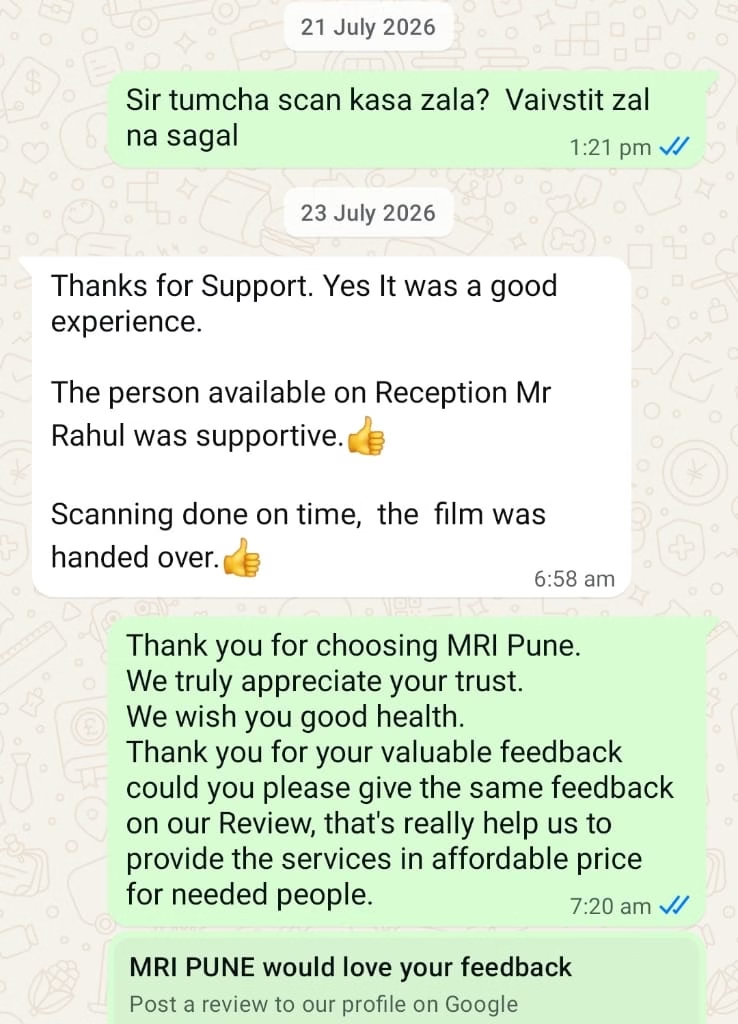
A recent patient’s experience: After completing his scan at one of our Pune partner centres, one patient shared this feedback with us: “Scanning done on time, the film was handed over. The person at reception was supportive.” Simple, on-time service and a supportive front-desk experience — exactly what we aim for with every patient who walks in, whether it’s their first scan or their fifth.